Belgium Pilot · 2026 | Independent Investigation | money-monitor.eu
EU money is public.
The trail is not.
€7.89 billion in EU grants. 758 verified NGOs and not-for-profits. Four official public registries. No EU institution had ever connected them. One journalist did.
€7.29 bn
EU grants to Belgian NGOs mapped and verified, 2014–2024.
758
NGOs & non-profits verified
across 4 public registries
22,179
FTS grant records for Belgian NGOs, 2014–2024.
1,115 / 8
OLAF fraud signals received
vs. investigations concluded
Belgium 2014–2024
5
EU institutions formally
notified · all responses
published verbatim
An independent investigation by Anca Păduraru, founder of EU Money Monitor · Brussels, Belgium
13 May 2026
OLAF released country-level fraud data it had not published since 2018. Same data, same office, a new director — and only after we escalated. Two days after the pressure, the numbers appeared. Read more >>
INVESTIGATION | WHO WATCHES THE WATCHDOGS?
Belgium generated 36.1% of OLAF’s EU fraud signals between 2019 and 2024. More than France, Germany, Italy, and Spain combined.
OLAF concluded 6 investigations.
Request for access to documents under Regulation (EC) No 1049/2001, EASE 2025/6477 · OCM data released May 2026 · OLAF Annual Reports 2019–2024
975
/
6
Fraud signals about Belgium VS investigations closed
2019–2024.
OLAF fraud signals received vs. investigations concluded — EU-27, 2014–2024
Source: OLAF Annual Reports 2014–2024 · access-to-documents request EASE 2025/6477, OCM(2026)15968 · Analysis: EU Money Monitor
Belgium: fraud signals received vs. OLAF investigations concluded (2014–2024)
Cumulative totals 2014–2024 — EU-27
EU Money Monitor · EU-27 rate 21.8% = 1,017/4,670. Belgium 0.7% = 8/1,115. Luxembourg 0.0% = 0/347..
The European Anti-Fraud Office – OLAF, is the diagnostic instrument.
The Commission and Parliament rely on OLAF to claim oversight of EU money.
Belgium was also first in the EU for OLAF total criminal referrals to EPPO, 2021-2024. The table showing this data was also removed from the 2025 OLAF Annual Report without explanation. A new FOIA request has been filed. The previous table removed, of the country-level intake, was disclosed under a new Director-General. Both tables showed Belgium first. Both were removed without citing a legal basis.
Last published articles:


The invisible people behind 111 billion euros of EU-funded work.
The European Union pays for people, for hours worked. The Commission puts personnel costs at roughly two thirds of a
Brussels’ transparency lobby faces the transparency test
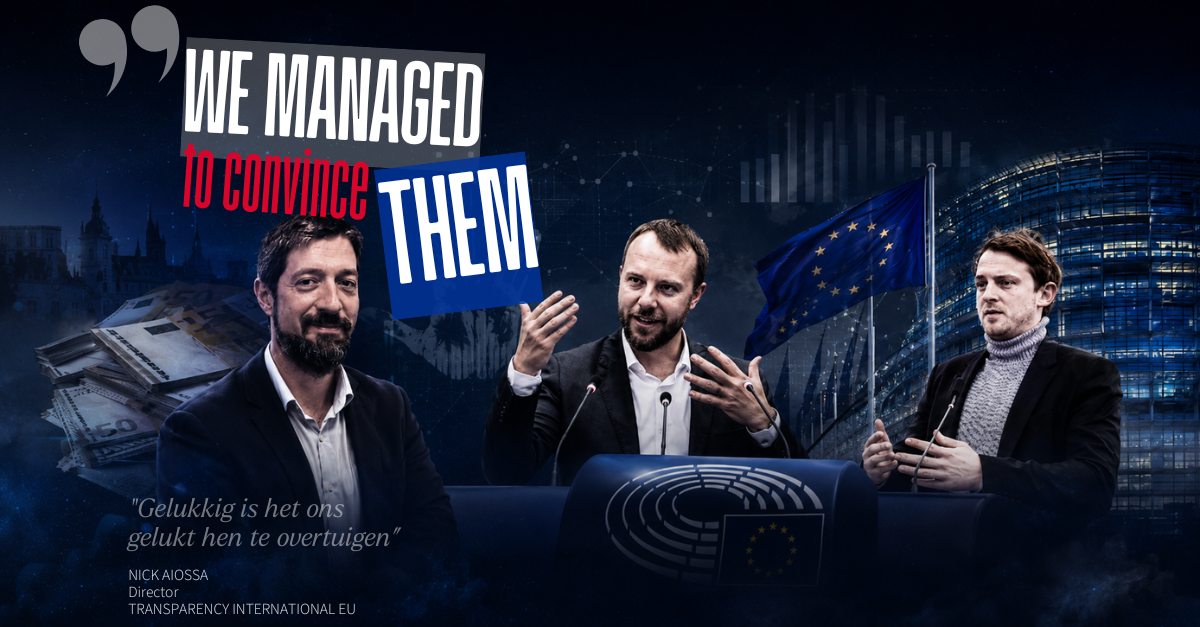
TI-EU branded Parliament’s NGO oversight group “illegitimate”. EU Money Monitor traced €7.29bn: invisible workforce, partial audits, removed OLAF tables and
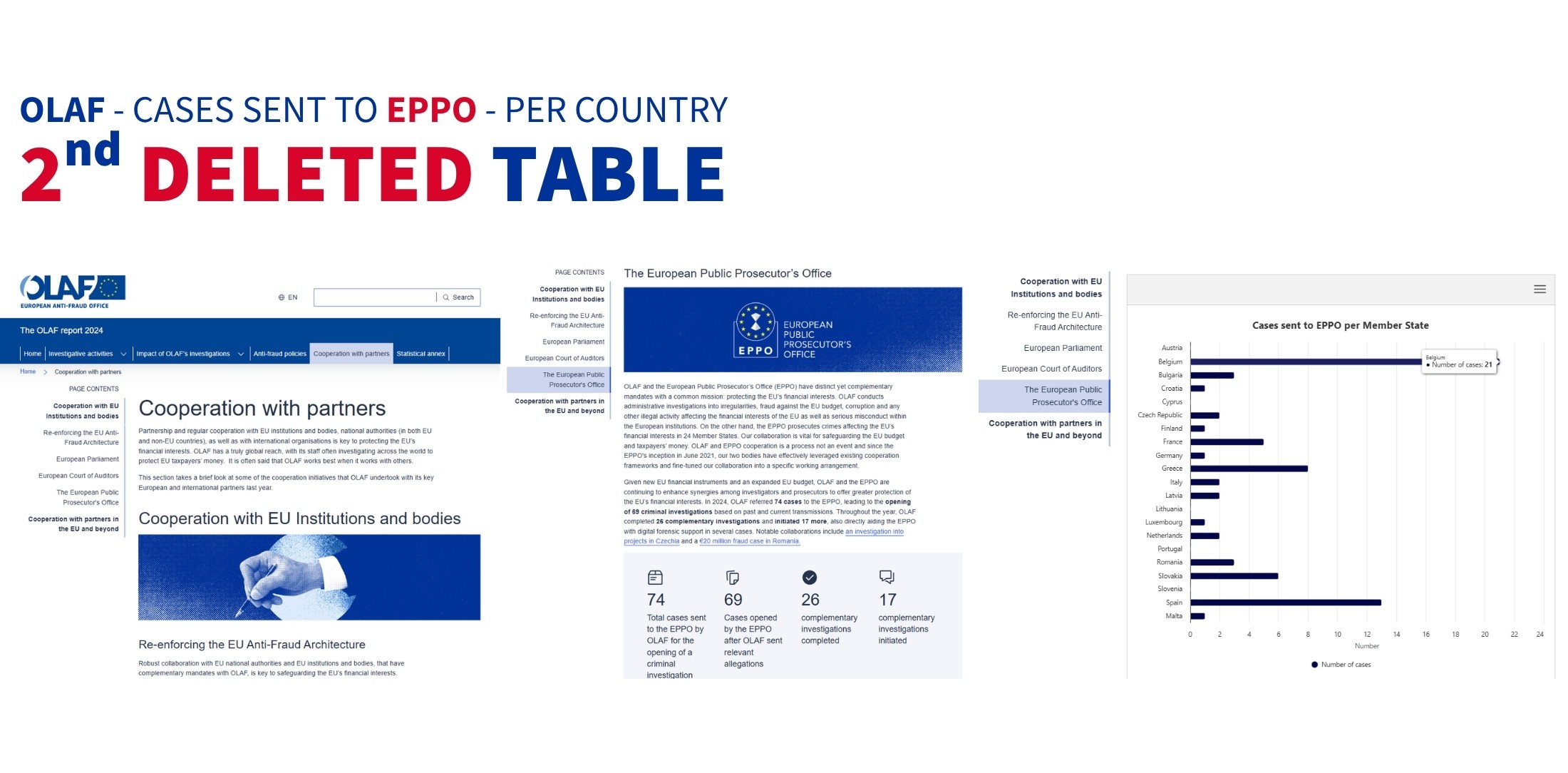
OLAF stopped publishing two fraud tables. Belgium was first in both.
Every year, OLAF, the European Anti-Fraud Office, publishes a mandatory annual report. It goes to four EU institutions: Parliament, Council,
INVESTIGATION | THE PLATFORM
Publication is not verification.
Nor is it transparency.
The EU publishes grant data. We test whether it can actually be checked, against legal identity, staff records and public accounts. For one country, one sector, for the first time.
01
Visible
What public records confirm.
Every figure comes from a named public registry, free to check. That is why no institution has disputed a single number.
FTS · CBE · ONSS · NBB · All public · All free · All verifiable
02
Plausible
What the evidence makes a fair question.
Named, sourced, never stretched. When 975 signals produce six closed cases, the record points to one thing: an oversight gap.
No institution has contradicted a single data point.
03
Provable
What only authorities can settle.
We put verified facts on the public record, entity by entity, so the system can finally be tested. That is their job. We made it possible.
Five institutions formally notified. All responses published.
EU Money Monitor does not allege, does not speculate, does not extrapolate. It documents what the public record confirms, names what the evidence supports, and asks institutions to do their part. The same standard. Every institution. Every country. No exceptions.
FINDINGS | The Numbers — Belgium Pilot 2026
What four public databases,
show for Belgium.
Every figure comes from a named public document or an access-to-documents reply. No institution has disputed any of them.
The identification gap
990
For 990 Belgian NGOs on the EU’s own grant list, no company number is published. For four in ten, there is no way to tell which legal entity received the money.
FTS Belgium, 05/03/2026 · Financial Regulation Art. 38
The disclosure floor
83.8%
8 in 10 Belgian NGOs that took EU grants publish no audited accounts. €3.82 billion was spent that no citizen can follow. French law would require an auditor; Belgian law does not.
NBB × FTS 2014–2024 · Belgian company law
The EU audit record
0.015%
Across every EU programme, only 45 staff-cost audits of Belgian NGOs have ever been published – a rounding error against the money. For Horizon Europe, the EU’s flagship research fund: zero.
access-to-documents request EASE 2025/5328 · Ares(2026)989413
The parallel grant load
€5.48bn
251 Belgian NGOs ran 10 to 889 EU grants at the same time, holding €5.48 billion. Nobody totals the workload across all parallel grants one organisation holds. The system was never built to ask.
FTS × ONSS · Horizon Europe rules
The invisible workforce
€1.20bn
298 Belgian NGOs with zero to four staff on the books managed €1.20 billion. The real workers are hired through other firms and booked under the same line as the rent. No names, no trace.
FTS × ONSS · Belgian law
The filing gap
€1.74bn
285 Belgian NGOs that took EU grants file no accounts in Belgium at all. €1.74 billion, with no public record of where it went. Belgian law does not require them to file.
NBB × FTS 2014–2024 · Belgian company law
European Court of Auditors
24 April 2026 · EUMM-ECA-2026-001
Your analysis confirms some of our observations presented in our report No 11/2025, which concern weaknesses in the Commission's transparency regarding the EU funding granted to NGOs."
European Court of Auditors, 24 April 2026. (The Court did not verify the legality of the spending.)
FINDINGS | The oversight chain
Five institutions. One test.
Can the system see the funding chain?
We notified the five EU bodies responsible for budget control, audit, anti-fraud, prosecution and discharge. None has contradicted a single finding.
European Court of Auditors
Substantive reply received
Confirmed in writing that our analysis aligns with its own 2025 report on weaknesses in NGO funding transparency.
European Commission
No reply
Addressed to the President and twelve named officials. Receipt not denied, no finding contested. Its own 15-day deadline passed on 6 May 2026.
European Parliament
No reply
Its budget-control chair said in 2025 there was still no full overview of EU funding to NGOs. We sent one. Twenty MEPs, deadline passed on 1 June 2026.

European Anti-Fraud Office
Findings not addressed
OLAF pointed us to its public fraud-reporting form. No finding answered, no file reference, no official named.
European Public Prosecutor's Office
Substantive reply received
Confirmed it cannot audit how grants are awarded or detect structural gaps in the system: it is not an audit body, and acts only on individual cases. Which leaves that oversight to OLAF and the Commission.
RESEARCH | The Numbers - Methodology
Research & methodology
EU Money Monitor publishes its methods in full. Every investigation rests on a working paper that names every source, shows every calculation, and documents every correction – deposited under a Creative Commons licence with a permanent DOI. A journalist, an auditor, a parliamentary researcher or a citizen can download it, check it against the public records, and reproduce it. That is what “verifiable” means here: not that you should trust the finding, but that you can test it. Both papers have been notified to the institutions named in them. None has contradicted a figure.
EU-27, 2014–2024
OLAF investigation-density Index
Concluded OLAF investigations per €1 billion received, for all 27 member states, built only from OLAF’s own reports and the Commission’s own expenditure data. Belgium: 0.57, 15th of 27, below the EU average of 0.79 – while raising the most fraud signals in the Union. Documents the denominator correction in full and carries OLAF’s right of reply.
Cite: Păduraru, A. (2026). Country-attributable OLAF investigation density: a reproducible index from the published anti-fraud record, EU-27, 2014–2024. EU Money Monitor. ZENODO DOI 10.5281/zenodo.20690853
Working paper · CC BY 4.0 · 14 June 2026
Belgium, 2014–2024
Belgium Pilot — can the public verify EU grants to non-profits?
The first entity-level, cross-registry dataset of EU grants to NGOs and non-profits for any member state: €7.29 billion verified across 758 entities, matched across four official public registries. It measures whether the public can actually verify where the money went, and documents where the record runs out.
Cite: Păduraru, A. (2026). Public verifiability of EU grants to non-profit beneficiaries: an entity-level, cross-registry method — The Belgium Pilot, 2014–2024. EU Money Monitor. ZENODO DOI 10.5281/zenodo.20685588
Working paper · CC BY 4.0 · 14 June 2026
Transparency
Stop weaponising transparency. Use it. Prove it. Live it.
Transparency is not a political stance. It is how an institution shows the public money went where it said. Lately it is used as a weapon, then called an attack the moment it points back. That reframing is the tell.
There is a contradiction at the centre of EU civil society. Groups that claim the authority of the public interest invoke private confidentiality the moment they are asked to account for public money, their staff, and where the grants actually go.
Civil society is conduct, not a legal form. It is the willingness to be checked. The strongest organisations want that test, it is the only thing that separates public-interest work from private gain dressed as virtue.
EU Money Monitor does not allege, does not speculate, does not extrapolate beyond what the public record shows.
An OLAF that can publicly demonstrate its investigative function is proportionate to fraud signals – with a published denominator, consistently applied – is a stronger institution than one whose annual report has been missing that denominator for six consecutive years. Questions do not weaken institutions. Unanswered questions do.
01
Publication is not verification
The EU publishes data. Publishing is not the same as making it checkable. We connected the data to legal identity, employer records and accounts. No institution had.
02
Transparency is not an attack
This is about the oversight system, not any organisation’s conduct. Every entity may be fully within the law. The question is whether the public can verify that.
03
A stronger EU starts here
Stop pretending the EU is already perfect if you want to improve it. A Union that can show citizens the full money trail is more credible than one that cannot.
Traceability
The questions citizens are entitled to ask. And institutions must answer.
Not investigative questions, but the basics any funded organisation, and any institution guarding public money, should be able to answer.
Who received the money, legally?
Not a name on a list. A registered entity: company number, legal form, active or closed.
Does the organisation employ people?
EU grants pay for work. Belgium has a public employer register. Is the organisation on it, and with how many staff?
How is the workforce actually paid?
Staff and outside contractors are both legal. Only one shows up in public records. The other looks like rent.
How much EU funding does each declared employee carry?
There are only so many hours in a year. How much public money does each declared person carry – and when does that stop being plausible?
How many grants run in parallel?
Organisations hold many grants at the same time. Nobody totals the workload. Does the declared staff match it?
What do their public accounts show?
Money went in. What does the record show coming out – revenue, costs, payroll, result?
The Case | five arguments
Five arguments.
None answered.
Not findings from the data, but arguments about how the EU’s accountability was built, where it breaks, and what that means.
01
The funding followed the institutions.
The accountability did not.
Belgium is the EU’s second-largest NGO recipient – €7.89 billion – ahead of France, Spain and Italy, though smaller than all of them. Brussels hosts every EU institution; the money followed. Oversight never caught up.
FTS EU-27, 05/03/2026
02
"No evidence of wrongdoing" is not a clean bill of health.
In 2025, 30 NGO groups boycotted Parliament’s scrutiny panel, citing “no evidence of wrongdoing.” Fifteen days later, prosecutors searched a Belgian EU-funded college and charged three people with fraud. “No evidence” describes a system not built to look.
TI-EU letters · OLAF reports
03
Parliament asked for this database in 2020. The Commission promised it by 2029. It already exists.
Parliament demanded a single, cross-programme database of EU NGO funding. The Commission committed to build it by 2029. Four existing public registries already hold it. The data was there; only the cross-check was missing.
EP Resolution 2020/2126
04
Accountability collapses at exactly the line Belgian law draws
Map staff and filings across all 758 entities and accountability does not fade gradually, it drops at one point: the size where Belgian law starts to require full accounts. One rule – full accounts for any beneficiary over €2 million – would close it.
dataset × ONSS × NBB
05
The investigation gap is built from the Union’s own data.
Concluded OLAF cases per €1 billion received, every member state. Belgium: 0.57, 15th of 27, below the EU average of 0.79 – while raising the most signals in the Union. To dispute it, an institution must dispute its own figures.
(OLAF reports × Commission expenditure reports · DOI
Transparency is not what auditors can access. It is what the public can verify.
If you work in EU oversight, scrutiny, journalism or research and want to use this – the conversation is open.
The case | The Belgium Pilot
One year. Four registries.
No institutional access.
Here is what it built.
The Belgium investigation generated a body of analytical work that is fully sourced, citable, and reproducible from public records. No claim requires access beyond official public portals that are free and open to anyone.
Full analytical dataset · PDF + Excel
Belgium NGO Funding Intelligence Pack
The full dataset: 758 entities, 29 data columns, 14 charts – the only cross-registry NGO funding dataset for any EU country. Built for newsrooms, auditors, parliamentary staff and researchers.
Briefings · Sessions · Speaking
Applied
Investigation
The method brought to your question. A briefing for a committee, a newsroom or a conference: what the public record shows for your member state, made usable.
Belgium is Volume I
Country Intelligence
EU-27
Belgium is Volume I. The same method covers €54.45 billion in EU grants to non-profits across all 27 countries. Each country, same standard, citable.
ABOUT
Anca Păduraru
I am Romanian. I moved to Brussels in 2018 because the EU is worth understanding, defending and improving. For six years I worked inside EU-funded organisations here. I know what the oversight system is not built to see.
“I believe we must stop pretending the EU is already perfect if we want to make it better. I am neither left nor right. My only argument: you wrote the rules to protect EU citizens. Now live by them.”
In 2024 I found a table OLAF had quietly stopped publishing — which countries raised the most fraud suspicions. Belgium was first. I asked for it; OLAF said it did not exist. I escalated. Under a new director, the data appeared two days later: 975 signals about Belgium, 36.1% of all EU fraud suspicions. Against that: six closed cases.
The full method and data are deposited and citable ➠ ZENODO
That sits inside a larger investigation: €7.89 billion in EU grants to Belgian NGOs, cross-checked for the first time across four public registries. 758 entities, no institutional access, no public funding, one year of work. Five institutions notified. None disputed a figure.

I built EU Money Monitor alone, from my kitchen table in Brussels, because transparency is not what auditors can access, it is what the public can verify.
EU Money Monitor · Belgium Pilot · 2026
Power fearless independent journalism
Keep institutions honest: your support means more pressure on those who think they’re untouchable, more investigations, more evidence.
Five institutions notified. Two methods published and citable. Zero figures disputed.